No. 14
Capitals riding high


The Skyriter is the little flat Smith-Corona, the one that travels in a zippered bag instead of a case. This one is by the look of it early fifties, and it came to me in a grocery sack from a woman at church who’d heard about “the typewriter room” from my wife. It had been her father’s. He carried it on the road selling farm equipment, she said, and typed up his orders on it in motel rooms. She didn’t want it back. She wanted it to work, and to be somewhere it would get used.
It nearly did work. Look at the end of the top strip, the part that goes NnHh. Those four characters are in my line for exactly this. A capital and its own lowercase, side by side, ought to stand on the same floor. Here the capitals are standing on a step. Go back to the P at the very start and it’s up there too.
Every capital, and only the capitals. That rules out the type right away, because forty-some bars don’t all bend the same amount on their own. When every capital is off together, it’s the shift.
How the shift lands
Each slug carries two letters, the capital above the small one.
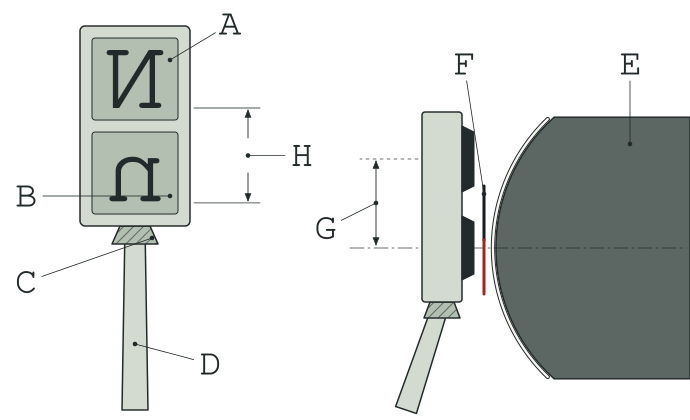
- A
- capital
- B
- lowercase
- C
- solder
- D
- typebar
- E
- platen
- F
- ribbon
- G
- shift travel
- H
- distance between the two baselines
Left, the face as it lies in the basket, which is why the letters read backward. When the shift is set right, G equals H.
To print a capital, something has to move by exactly the distance between the two. On this machine it’s the carriage: press shift and the whole carriage rises until it meets a stop. If the stop is right, the capital lands on the line. If the carriage comes up short, the paper is sitting a little low when the capital arrives, and the capital prints high.
On the Skyriter the stop is a screw with a locknut, and the locknut was finger-loose. Seventy years of shifting, or one bad afternoon in a suitcase, and the screw had walked.
The fix
A screwdriver, a small wrench, and patience. Type NnHh. Look. Turn the screw an eighth of a turn. Snug the nut, because snugging the nut moves the screw. Type it again.
I did that eleven times, and I have the slip to prove it: a ladder of NnHh down the page, the capitals coming down a hair at a time until the ninth, overshooting on the tenth, and back on the eleventh.
Why N and H, if you’re wondering: flat feet. A round letter like O or C hides a small error, because there’s no flat bottom to judge by. With N next to n and H next to h, you can see a hair.
Not fixed
The capitals are still a little lighter at the bottom than at the top. I think that’s the same story from another angle, the face meeting the curve of the platen slightly off, and there may be a second adjustment for it that I haven’t found. It’s faint. I’m leaving it for a day when I’m braver.
Three evenings, one of them nothing but the ladder. I typed her a thank-you note on it when it was done, capitals and all.
We had the first morning this week when I opened the windows. Sixty-eight degrees at seven o’clock. I don’t care what the calendar says; that’s the first day of fall here.
On its tag
- Came from
- A woman at church, in a grocery sack. It had been her father’s.
- Trouble
- Every capital printing high. Locknut on the shift stop loose, screw walked.
- Done
- Stop screw reset an eighth of a turn at a time, eleven tries, and locked.
- Not done
- Capitals still a little light at the bottom. There may be a second adjustment I haven’t found.
- Evenings
- Three.