No. 13
A space it didn’t earn


The Quiet-Riter is a brown-and-tan Remington portable, big for a portable, by the look of it mid-fifties. It came from an estate sale in a mobile home park outside Zephyrhills, where everything in the house had a round orange sticker on it. The typewriter’s said AS IS. I’ve learned to like those words. They mean nobody has sprayed anything into it lately.
Look at the top strip and count the gaps. There’s one in the middle of with. One after the d in dozen. Another inside liquor. The letters themselves are clean and level, the ink is even, and every so often the carriage takes a space it didn’t earn.
That’s the escapement. I’ll admit it’s the mechanism I understand least on these machines, so take what follows as one man’s notes and not a manual.
What’s supposed to happen
The mainspring is always pulling the carriage to the left. The only thing stopping it is a toothed wheel, geared to the carriage, with a small catch stuck in its teeth. The catch is called a dog. There are two of them on a rocker, side by side: one fixed, one loose and on a spring.
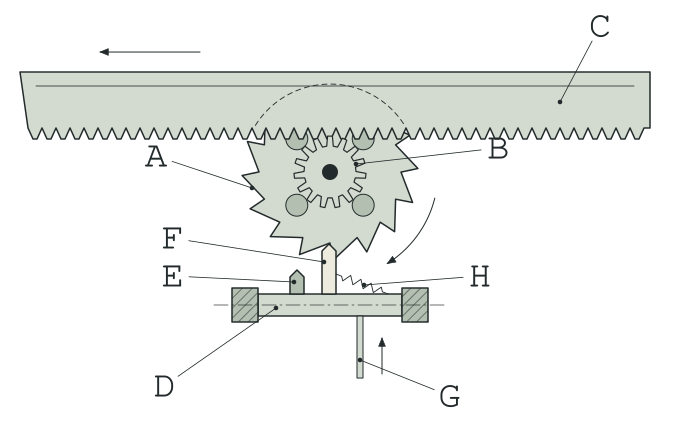
- A
- escapement wheel
- B
- pinion, on the same shaft
- C
- carriage rack
- D
- rocker
- E
- fixed dog
- F
- loose dog
- G
- link from the keys
- H
- loose-dog spring
From above, and not to scale. The straight arrow is the way the mainspring pulls the carriage.
Press a key and the rocker tips. The loose dog comes out of the tooth it was holding and the fixed dog steps in to catch the wheel. Let the key up and they trade back, but the loose dog, being on a spring, has hopped ahead, and it lands in the next tooth. One tooth, one space. It’s a clock escapement that ticks when you tell it to.
A skip means the wheel got past two teeth instead of one. Either the loose dog was slow getting back in, or it’s worn and didn’t hold.
What I found
Slow. With the machine on its back and a flashlight in my teeth, I could push the loose dog with a toothpick and watch it come back like it was moving through honey. Old oil again. It’s nearly always old oil.
And it only skipped on fast pairs, th and er and ou, the ones your hands rattle off without asking you. That’s when the dog has the least time to get home.
What I did
Mineral spirits on a small artist’s brush, worked into the dog’s pivot and its spring from underneath, a dozen passes, moving the dog with the toothpick between each one until it snapped back sharp. Then the teeth of the wheel, the pinion, and the whole length of the carriage rack, which had a gray paste in it. Then one drop of light oil on the dog’s pivot, off the end of a pin. And I mean one. I counted.
I also backed off the mainspring a little. Somebody before me had it wound tight, maybe to cure a sluggish carriage, and a hard pull makes it easier for the wheel to get away. I’d learned that on No. 10, coming from the other direction.
Where it stands
Better, not cured. The bottom strip is clean, and I typed a full page after it with two skips, both after th, both when I was going faster than I really type. Under a loupe the tip of the loose dog looks a little rounded over to me. If that’s wear, it’s past what cleaning fixes, and reshaping a hardened part that small is beyond what I’ll try with the tools I own. So it’s a machine for a deliberate typist. I’ve written that on its tag.
Six evenings, with a week off in the middle while the grandkids had the guest room. The typewriters spent that week under their dish towels and nobody under four feet tall was allowed to lift one. Those were my terms.
On its tag
- Came from
- An estate sale in a mobile home park outside Zephyrhills. The sticker said AS IS.
- Trouble
- Escapement skipping on fast pairs of letters. Loose dog slow to return. Mainspring wound tight.
- Done
- Dogs, wheel, pinion and rack cleaned with mineral spirits. One drop of oil on the dog’s pivot. Spring backed off.
- Not done
- Still skips now and then after th at speed. The tip of the loose dog looks worn.
- Evenings
- Six, with a week off in the middle.