No. 15
The t still sits a hair high


My neighbor across the street has a garage I’m not allowed to describe. In September he was making room for a chest freezer and found, behind a stack of paint cans, an Underwood standard: the tall black office machine, open at the sides, the kind that sits on a desk in every newspaper movie. He doesn’t know whose it was. It came with the house. He and his son-in-law brought it over on a furniture dolly, because it weighs right around thirty pounds and neither of them wanted to be the one who dropped it.
By the look of it, the twenties or thirties. I’m going by pictures and could be off by a decade either way. It’s the oldest thing on the shelf by a good margin, and the first one that needed a shelf to itself.
After however many years in a Florida garage, I expected a block of rust. It wasn’t that bad. There’s a lot of nickel on an Underwood. The bars were slow (a segment flush, two evenings; you know the routine by now), the ribbon was a fossil, and the drawband, to my surprise, was fine. Then I typed the line.
That’s the top strip, and it’s the reason I call these type samples. Nothing’s faint and nothing’s skipped. Every letter is just standing in the wrong place. The t rides high. The e sits low and leans back like it’s in a recliner. The o is up, the s is down, the a tips forward. Read along the bottoms of the letters instead of reading the words, and it looks like a row of teeth.
Why they wander
Each letter is a slug soldered to the end of a long, thin steel bar, and where the letter lands depends entirely on the shape of that bar.
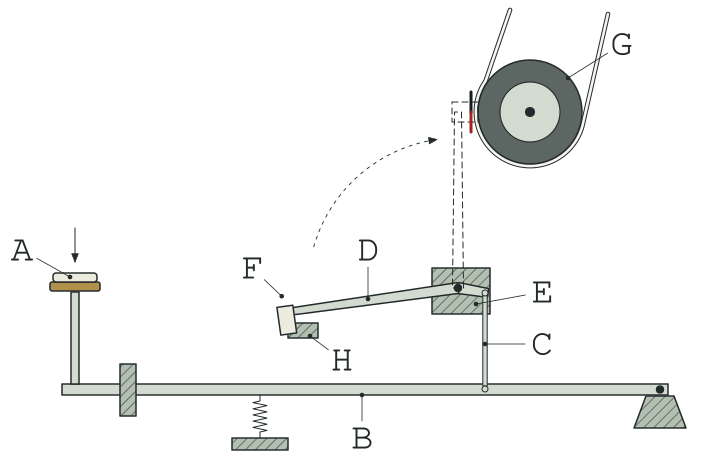
- A
- key
- B
- key lever
- C
- link
- D
- typebar, at rest
- E
- segment, with the pivot wire
- F
- type slug
- G
- platen and paper
- H
- rest pad
Broken line: the same bar at the instant it prints. A real machine has more joints between B and D than I’ve drawn.
Bend the bar a hair up or down and the letter prints high or low. Twist it and the letter leans. Bars get bent by jams, two keys at once and somebody in a hurry forcing them apart, and by people lifting the machine with their fingers in the basket, and by eighty years. On an office machine that got pounded eight hours a day the common letters take the most abuse, and that’s exactly who’s out of line here: t, e, o, s, a.
What I did
The proper tools for this are special pliers with three prongs that put a controlled kink in the bar. I don’t own a set. I own two pairs of smooth-jawed pliers with the jaws wrapped in electrical tape, and I own time.
The method, such as it is: pick one letter. Type it between two good neighbors, so you can see exactly how far off it is and which way. I used ntn, nen, non, because the n was true. Bring the bar up by hand until it’s resting in the guide. Hold it low with one pair of pliers, and with the other, near the slug, give it less of a bend than you think it needs. Type it again. It won’t have moved enough. Do it again. The one time you get impatient is the time it goes past, and then you’re bending it back, and steel remembers every time you do that.
One letter an evening was about my speed. The e took two, since it was low and leaning, and those are separate corrections: height first, then the twist, then height again, because fixing the twist moved it.
I kept every slip. The pile for this machine is about half an inch thick.
What I didn’t get
The t. I got it most of the way down and it stopped answering. I’d bend, and it would print the same. Bend a little more: the same. A little more, and suddenly low. Three rounds of that. I finally put it back to a hair high and quit while the solder was still holding. You can find it in the bottom strip if you look, in with. I can live with it. I’ve decided it’s the machine’s accent.
The platen is hard, though not Olympia hard. The bell is loud enough for both of them. There’s no 1 key, which is normal for the age; you type a lowercase L. It’s why my line starts its figures at 2.
Eleven evenings over five weeks. I finished on the first one cool enough to have the window open, with the dehumidifier switched off for the first time since May and the season down to its last few weeks. My neighbor came over to see it. He typed his name, looked at it for a while, and asked if I wanted the freezer too.
On its tag
- Came from
- The garage across the street, behind the paint cans.
- Trouble
- Five typebars bent or twisted: t and o high, e and s low, e and a leaning. Bars slow. Ribbon fossilized.
- Done
- Segment flushed. Bars bent back a little at a time with two pairs of taped pliers. New ribbon.
- Not done
- The t is still a hair high. Platen hard.
- Evenings
- Eleven, over five weeks.