No. 10
Fishing line and five turns


The neighbor two doors down was clearing out his late mother’s condo in New Port Richey and walked over with a tweed case. “You’re the typewriter guy,” he said, which I suppose I am now. Inside was a Smith-Corona Silent-Super, a tan one, by the look of it late fifties, clean as a dinner plate. He wanted nothing for it. I sent him home with a jar of my wife’s orange marmalade and we called it even.
I set it on the bench, rolled in a slip, and typed the line. The carriage never moved. Forty-six characters, one on top of the other, at the left margin. That’s the top strip. It’s the only type sample I’ve ever made that you could also call a period.
That one I didn’t need to study. Tip the machine up and there’s the drawband, the cord that pulls the carriage along, lying in the bottom like a dead shoelace, and the mainspring drum sitting there fully unwound with nothing to do. The cord was cotton, or had been. It came apart in my fingers. However many summers in a closed-up condo will do that to cotton.
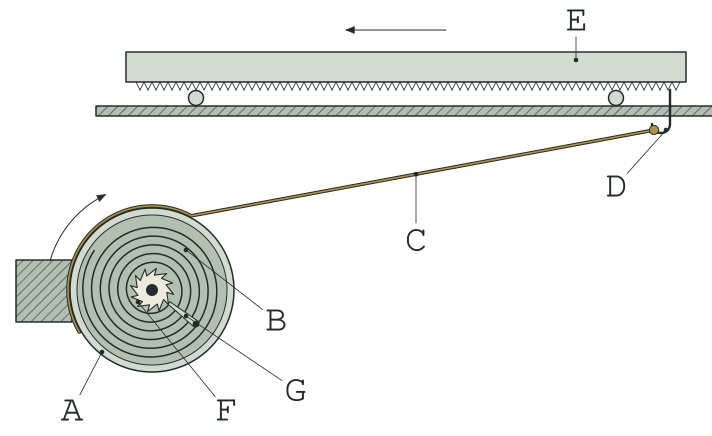
- A
- mainspring drum
- B
- mainspring
- C
- drawband
- D
- hook on the carriage
- E
- carriage
- F
- ratchet for setting the tension
- G
- pawl
From the back of the machine. The arrow over the carriage is the way it travels as you type.
First try: three turns
For the new cord I used fifty-pound braided fishing line, the green kind, off a spool I already had. It doesn’t stretch and it doesn’t rot. I tied a figure-eight knot for the drum end and fed it through the hole in the drum. Then I routed the cord under the carriage the way the old one had lain in the dust (dust keeps a good record) and tied a loop for the hook at the far end of the carriage.
Then the spring. The drum has to be wound before you hook up, so that the spring is still pulling when the carriage is all the way over at the end of a line. I had no number for this machine, so I guessed three turns.

Three turns types like that. Fine for the first two-thirds, and then, as the spring runs down toward the end of its travel, the carriage stops keeping up and the letters start leaning on each other. By the figures, they’re stacked. A weak pull always shows at the end of the line and never at the beginning, because the beginning is where the spring is wound tightest.
Second try: seven turns
Too much. The carriage slammed left on every keystroke like it was mad at me, and the escapement started skipping: a blank space every dozen letters or so, where the wheel got yanked past a tooth. I didn’t save that slip. I should have.
Third try: five
Five turns types the bottom strip. With the carriage at the far end of the line there’s still a little pull left when I tug the cord with one finger, and that’s the test I’m going with from now on: some pull left at the end, and no more than that.
Two things I’d tell myself next time. Hold the drum with a thumb the whole time you’re hooking up, because if it gets away it unwinds in about a second, the cord whips, and you start over. And tie the loop before winding, not with one hand while the other hand holds five turns of spring.
Not fixed
Nothing in the mechanism, for once. The feet have gone flat and hard, and it walks across the bench when I return the carriage with any enthusiasm. Feet are on a list.
Three evenings, most of the second one spent working out where the cord goes.
On its tag
- Came from
- A neighbor two doors down, out of his late mother’s condo.
- Trouble
- Cotton drawband rotted through. Mainspring fully unwound.
- Done
- New drawband of fifty-pound braided fishing line. Spring wound three turns, then seven, then five.
- Not done
- The rubber feet are flat and it walks across the bench.
- Evenings
- Three.