No. 11
Everything rubber had quit


The Olympia came from a church rummage sale in Zephyrhills, under a table, in its case, with a strip of masking tape on the lid that said WORKS. It’s an SM3, the heavy German portable with the rounded shell, in a dark green-gray; by the look of it late fifties. It went a little over sixteen pounds on the bathroom scale, case and all. And WORKS was true, in the sense that every key put a letter on the page.
The top strip tells the rest. The line runs downhill. It starts where I put it and ends a good eighth of an inch lower. And the period after jugs isn’t a period, it’s a hole. Hold the slip up to the window and light comes through. The o’s are cut nearly free, like little washers.
None of that is the type, the ribbon, or the alignment. It’s rubber. Everything on this machine that was made of rubber had quit, each part in its own way, and I’ll go through them in the order I found them.
The platen
A platen is supposed to give a little. You can press a thumbnail into a good one and watch the mark fade. This one I could have played pool with. When type hits a platen that hard there’s no cushion: the sharp parts of the letter go right through the paper, and the period, which is all sharp part, goes through first. It’s also loud. My wife asked from the kitchen whether I was using the staple gun.
I can’t fix a hard platen. There are shops that grind the old rubber off and put new on, and someday I may send one out, but I haven’t, and this journal is about what I can do in a guest room. What I did was scuff the glaze off with 400-grit paper wrapped around the platen, turning it by the knob, and then wipe it with a rag barely damp with water. That helps the grip and does nothing for the hardness. So I type on it with a backing sheet, two sheets in instead of one, and the second sheet takes the beating. The bottom strip was typed that way.
The feed rollers
These are the small rubber rollers under the platen that pinch the paper against it. They’d been sitting pressed against the platen in one position for decades, and each one had a flat on it, like a tire on a car that never moved.
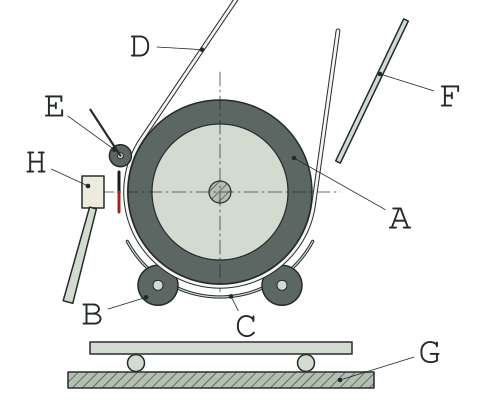
- A
- platen: rubber over a core
- B
- feed roller, with a flat worn in it
- C
- paper pan
- D
- the sheet
- E
- bail roller
- F
- paper table
- G
- carriage rail and bearing
- H
- slug and ribbon at the printing point
Cut straight through the middle, looking from the left end.
A roller with a flat grabs, slips, grabs. The paper goes in crooked and stays crooked. That’s the downhill.
The fix I borrowed from people who’ve done this longer than I have: heat-shrink tubing. I pulled the rollers, cleaned the old rubber with a rag, slid a length of tubing over each, and shrank it with my wife’s hair dryer, which I’ve been told to replace. Two layers on the front pair, one on the back. They’re round again, and grippy. It isn’t rubber and it won’t last like rubber, but the paper goes in square.
The bushings
This is the one that had me fooled. The carriage scraped on the way back, a dry, dragging sound, and the shift felt like lifting a window that’s been painted shut. I cleaned the rails. Twice. No change.
The works of this machine sit inside the shell on four rubber bushings, and all four had squashed down to about the thickness of a nickel. That let everything ride low in the shell, low enough that the carriage rubbed the body on every return. I measured what was left of one, guessed at what it used to be, and stacked two flat faucet washers from the plumbing aisle at each corner. The scrape is gone. The shift is still heavy, but it’s the honest heaviness of lifting a carriage that size, and I’m told they all do that.
The feet
Hard as buttons, and one missing. I haven’t done anything about them. It sits on a square of drawer liner.
Where it stands
Seven evenings, spread over three weeks because I was waiting on tubing in the right diameter. It types a straight, clean line with a backing sheet, and it will still punch a period through a single sheet of copy paper. I’m calling it half fixed. It may be the best-built machine on the shelf, and the rubber gave out on it anyway.
The afternoon storms have started, by the way. The first real one came through while I had the rollers out, and the lights flickered twice. More on what that does to this hobby another time.
On its tag
- Came from
- A church rummage sale in Zephyrhills, under a table, in its case.
- Trouble
- Platen hard as a cue ball. Flats on the feed rollers. Four bushings squashed thin. Feet gone.
- Done
- Platen scuffed with 400-grit. Feed rollers sleeved in heat-shrink tubing. Bushings replaced with stacked faucet washers.
- Not done
- The platen is still hard; I type on it with a backing sheet. Feet untouched.
- Evenings
- Seven, over three weeks.